
That single change in cell chemistry allows a softwood to outperform Siberian Larch, Western Red Cedar, Thermowood, and even tropical hardwoods like Ipe in dimensional stability and rot resistance.
For architects and specifiers, the real question is whether that performance justifies the price premium, and how Accoya compares to competing species across a 30 to 50-year service life in 2026 specifications. The answer depends on climate exposure, finish strategy, and how much movement the façade detail can tolerate.
The following sections explain the acetylation process, the science behind the 50-year above-ground warranty, an honest comparison against the four most-specified alternatives, and the trade-offs worth weighing before committing to an Accoya façade.
What Is Accoya and How Acetylation Works
Accoya is a modified timber manufactured from FSC-certified, fast-growing Radiata Pine sourced from sustainably managed plantations in New Zealand and Chile. The pine is transformed through acetylation, a non-toxic chemical modification that gives a softwood the dimensional stability and durability of premium tropical hardwoods.
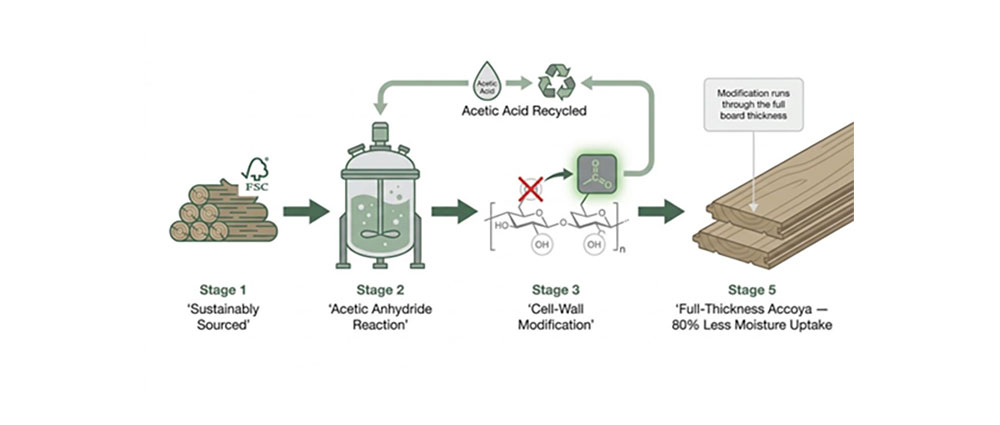
Acetylation works at the cell-wall level. Free hydroxyl (-OH) groups in the wood react with acetic anhydride and are replaced by acetyl groups, drastically reducing the wood's ability to absorb moisture.
Think of hydroxyl groups as tiny sponges that grab water from the air, causing the timber to swell, shrink, and warp. Acetyl groups do not attract water, so the wood effectively stops responding to humidity changes.
The modification is permanent and runs through the full thickness of every board, unlike pressure-treated or surface-coated alternatives that only protect the outer layer. As a result, freshly cut Accoya boards perform identically to the surface.
The process itself is non-toxic. Its only by-product is acetic acid, the same compound found in household vinegar, which is recycled back into the manufacturing loop.
Why Accoya Is the Most Dimensionally Stable Cladding Species
Accoya shows roughly 3 to 4 times less swelling and shrinkage than unmodified softwoods, the strongest dimensional performance of any commercially available cladding timber. That figure, confirmed in independent testing referenced by manufacturers and the UKGBC, is the technical reason specifiers reach for Accoya on demanding façades.
In practical cladding terms, dimensional stability means boards arrive straight and stay straight. They resist warping, twisting, cupping and bowing across seasonal humidity swings, so a façade installed in summer still looks aligned after a wet winter.
The cause sits at the cell-wall level. Acetylation reduces moisture uptake, so the wood reaches a low equilibrium moisture content and largely stops responding to changes in ambient humidity. Without that constant wet-dry cycling, the board has little reason to move.
Coatings benefit directly from this calm substrate. Paints and stains sit on a surface that barely expands or contracts, so finishes typically last 2 to 3 times longer, with fewer hairline cracks, blisters and peel-offs along the grain.
The downstream effects matter on site. Tongue and groove joints stay tight, rainscreen gaps remain consistent, and façade lines read cleanly years after handover. For installers and architects, that translates into fewer callbacks, predictable detailing, and long-term aesthetics that hold up as the building ages.
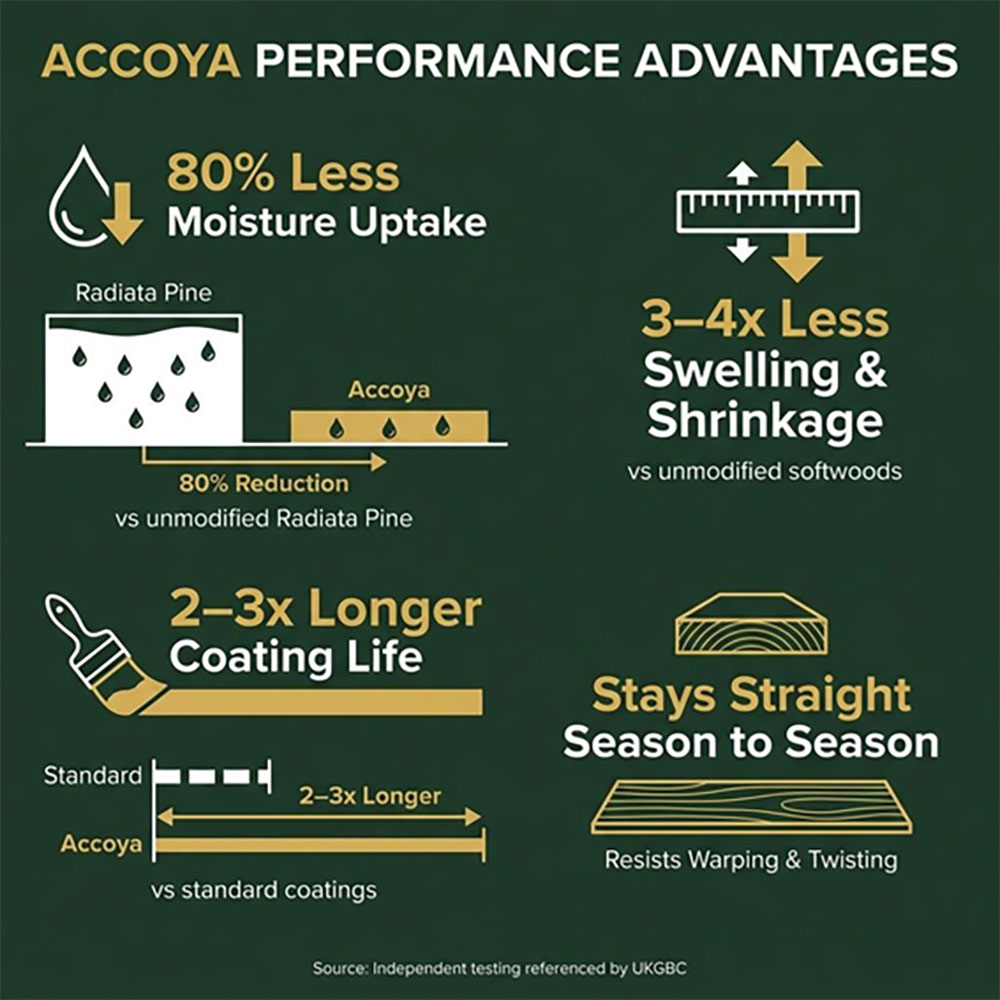
Statistics infographic showing Accoya dimensional stability data: 80 percent less moisture uptake, 3 to 4 times less swelling and shrinkage than softwoods, and coatings lasting 2 to 3 times longer compared to unmodified timber
Key Benefits of Accoya for Cladding
Accoya delivers a four-pillar value proposition for façades: stability, durability, sustainability, and low maintenance. Each pillar reinforces the others, which is why architects increasingly specify it for projects with long service horizons.
On durability, Accoya carries Class 1 rating per EN 350, the highest available, backed by a 50-year above-ground warranty and a 25-year warranty for in-ground or freshwater use. Independent testing shows it is roughly 22 times more resistant to termite attack and effectively immune to fungal decay, because acetylation alters the wood chemistry so microorganisms no longer recognise it as food.
Sustainability credentials are equally strong. Accoya is FSC-certified, holds Cradle to Cradle Gold, and contributes positively to BREEAM and LEED scoring. Its low embodied carbon, spread over a 50-year service life, gives it one of the lowest lifetime impact profiles of any cladding timber.
Low maintenance is where specifiers see the clearest cost benefit. Coatings last 2 to 3 times longer on a stable substrate, so recoat intervals stretch significantly. Factory pre-coated or pre-greyed Accoya pushes this further, offering near-zero deferred maintenance, a key advantage on tall or hard-to-access façades.
Specification flexibility rounds out the picture. Accoya machines cleanly into:
- Rainscreen cladding systems with concealed or expressed fixings
- Tongue and groove profiles for tight, weather-tested joints
- Shiplap and bespoke milled profiles
Common cladding thicknesses range from 19 to 32 mm, suiting both ventilated façades and traditional timber elevations.
Accoya vs Other Cladding Species: Siberian Larch, Thermowood, Cedar & Kebony
Beyond Accoya's headline performance, the right cladding species depends on how long the façade must perform and how much maintenance the owner accepts. The table below compares the five most specified options on the criteria specifiers actually weigh.
|
Species |
Stability |
Durability (EN 350) |
Service life |
Maintenance interval |
Upfront cost |
Sustainability |
|
Accoya |
Best in class |
Class 1 |
50+ years |
Longest |
Highest |
FSC + C2C Gold |
|
Siberian Larch |
Moderate |
Class 3 |
25–30 years |
Frequent |
Low |
FSC available |
|
Thermowood |
Good |
Class 2–3 |
25–30 years |
Medium |
~½ of Accoya |
PEFC available |
|
Western Red Cedar |
Moderate |
Class 2 |
30–40 years |
Medium |
High |
Old-growth pressure |
|
Kebony |
Very good |
Class 1 |
30+ years |
Long |
Comparable to Accoya |
FSC available |
Siberian Larch offers the lowest entry price but moves noticeably with humidity and silvers unevenly, especially on elevations with mixed sun and shade exposure.
Thermowood gains rot resistance through heat treatment, yet the same process makes it more brittle and less suitable for load-bearing fixings near board ends. Service life lands around 25 to 30 years.
Western Red Cedar brings natural beauty and a Class 2 rating, but supply increasingly relies on old-growth stock, raising both ethical and price concerns.
Kebony is the closest competitor, modified through furfurylation rather than acetylation. Stability and durability are comparable, pricing sits in the same band, and the main visual difference is Kebony's darker brown tone against Accoya's pale, paintable finish.
Accoya earns its premium when the project demands a 50-year horizon, minimal maintenance access, and long coating intervals. For shorter-horizon builds or tighter budgets, larch or thermally modified pine remain rational choices.
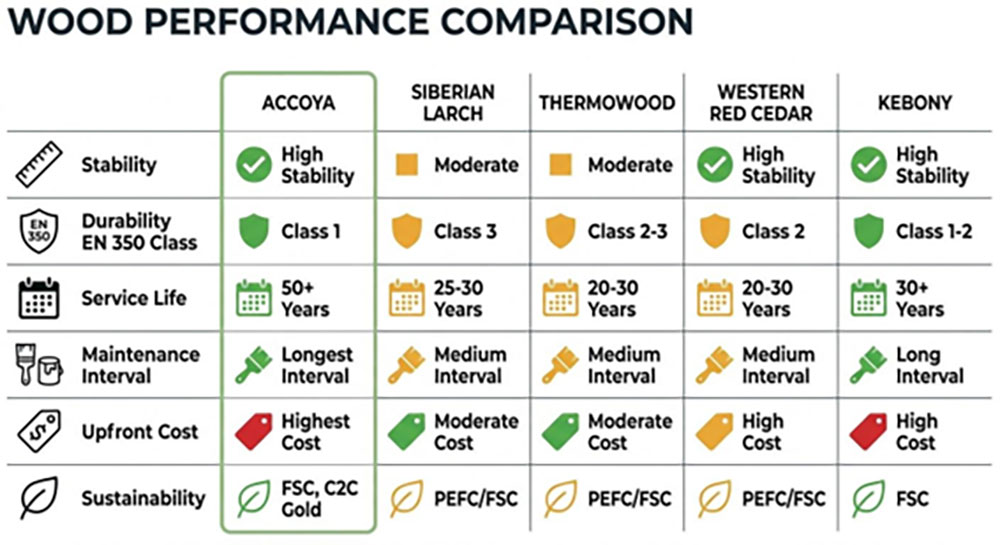
Comparison chart of Accoya vs Siberian Larch, Thermowood, Western Red Cedar and Kebony cladding species across stability, EN 350 durability class, service life, maintenance interval, cost and sustainability
Disadvantages and Limitations of Accoya
No cladding material is perfect, and Accoya carries trade-offs that specifiers should weigh openly before committing to a façade.
The most obvious is cost. Accoya typically sells at roughly twice the price of Thermowood and sits comparable to or above Western Red Cedar and tropical hardwoods like Ipe. For projects driven by upfront budget rather than lifetime value, that premium is hard to absorb.
Board geometry is another constraint. Because the raw material is Radiata Pine, available lengths and widths are limited by the size of the parent log. Large monolithic façades therefore often require staggered joins or careful detailing rather than continuous full-height boards.
In humid coastal or persistently rainy climates, freshly installed Accoya can develop light surface mildew spotting during its first months of weathering. The fix is straightforward: a mildew-inhibiting stain or factory pre-coated finish prevents the issue from appearing at all.
Acetylation also slightly increases brittleness compared with unmodified softwood. Pre-drilling near board ends is recommended to prevent splitting around fixings, especially on rainscreen profiles with exposed nails or screws.
Finally, distributor experience varies. Buyers should confirm lead times, technical support, and warranty registration procedures upfront so the 50-year guarantee is properly logged.
Framed against a 50-year service life, minimal recoating, and almost no replacement cost, these drawbacks shift the conversation from sticker price to total cost of ownership, where Accoya generally outperforms cheaper alternatives over the building's lifespan.
Why Accoya Is the Most Stable Cladding Species: FAQ
How Stable Is Accoya Wood?
Accoya is the most dimensionally stable commercially available cladding timber, with roughly 3 to 4 times less swelling and shrinkage than traditional softwoods such as pine, spruce or larch.
Boards arrive straight and stay straight even under repeated wet-dry cycling, because acetylation permanently converts hydroxyl groups inside the cell walls into acetyl groups. The wood loses its ability to absorb moisture at a molecular level, so it stops responding to humidity swings. The result is tighter joints, fewer callbacks, and coatings that bond reliably across decades of seasonal movement.
What Wood Is the Most Stable for Cladding?
Acetylated woods such as Accoya lead the market in dimensional stability, outperforming Siberian Larch, Western Red Cedar, and thermally modified species like Thermowood. Stability is measured by how much a board moves under humidity swings, expressed as a swelling coefficient.
In independent laboratory testing, Accoya consistently records the lowest values, because acetylation reduces moisture uptake at the cell-wall level. Kebony, modified through furfurylation, comes closest, while traditional softwoods and even durable hardwoods show noticeably more seasonal movement on a façade.
What Is the Disadvantage of Accoya Timber?
The main drawbacks are a higher upfront cost (often double the price of Thermowood and comparable to Ipe), limited maximum board lengths and widths because the source material is Radiata Pine, and the need for a mildew-inhibiting stain or pre-coated finish in humid coastal climates to prevent surface spotting during initial weathering.
Acetylation also makes the wood slightly more brittle, so pre-drilling near board ends is recommended. These trade-offs are typically offset across the 50-year service life through fewer recoats, reduced replacement, and lower lifetime labour costs.
What Are the Main Benefits of Using Accoya for Cladding?
Accoya delivers four core benefits: dimensional stability that prevents warping and cupping, Class 1 durability backed by a 50-year above-ground and 25-year in-ground warranty, strong sustainability credentials (FSC and Cradle to Cradle Gold), and very low maintenance.
Pre-coloured or factory pre-greyed charred accoya cladding extends those benefits further, achieving near zero deferred maintenance. That is why architects often specify it for tall or low-access façades, where scaffolding for repainting becomes a major lifetime cost.
At TimberSol, we combine the dimensional stability of acetylated timber with the timeless character of Yakisugi to create cladding that performs as beautifully as it looks. Our charred Accoya range brings together a 50-year above-ground warranty, Class 1 durability, and the deep, textured finish of traditionally charred wood, making it an ideal choice for architects and homeowners who refuse to compromise on either longevity or aesthetics.
Whether you are specifying cladding for a coastal residence, a contemporary extension, or a high-end commercial façade, our team is ready to help you select the right profile, finish, and dimensions for your project. Reach out to discuss bespoke sizes, samples, or technical guidance, and let us help you build something that will still look remarkable decades from now.